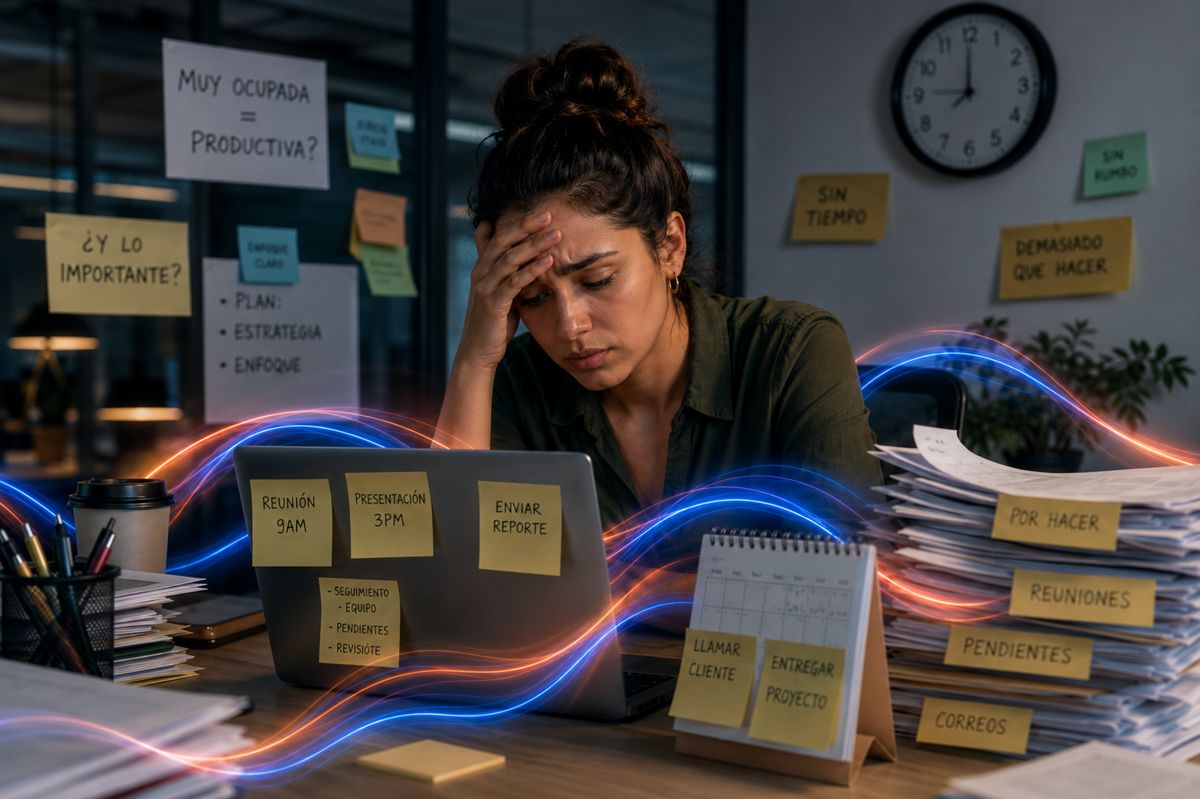
Why Being Busy Is Not the Same as Being Productive
Originally published in News is my Business — July 6, 2026 ↗
Let me ask you something uncomfortable: When was the last time you felt truly in control of your day?
Not rushing between meetings. Not drowning in emails. Not juggling tasks while convincing yourself that speed equals progress. I mean in control — knowing exactly where your energy was going and why.
If that question stings, you are not alone. And you are not lazy. You are likely caught in what I call the busyness ego: the silent trap where being needed feels powerful, speed feels like importance, chaos feels like relevance, and overwork signals status. It is a cycle — stimulus, reaction, validation, repeat. And it is quietly destroying our capacity to create real value.
I know this firsthand. In my late 20s, I was working 13 to 16 hours a day, six days a week. I was overweight, barely traveling, medicated for blood pressure, and battling anxiety. I was not efficient. I was surviving — and mistaking survival for performance.
That experience forced me to confront something most professionals and organizations refuse to examine: personal inefficiency does not stay personal. It bleeds directly into professional execution. When you are running on empty, every decision is slower, every process more fragile, every meeting less productive. You become the first broken piece in a broken system.
The Myths We Need to Leave Behind
Our culture has built an entire productivity mythology that keeps us trapped. The idea that waking up at 5 a.m. makes you more effective. The belief that multitasking is a skill worth developing. The assumption that more hours equal more output.
Research tells a different story. Studies consistently show that peak cognitive performance varies by individual, not by alarm clock. And multitasking, far from being a superpower, reduces efficiency by up to 40% while increasing errors. We are not doing more. We are doing more things badly.
“There is surely nothing quite so useless as doing with great efficiency what should not be done at all.” — Peter Drucker
Efficiency is not about speed. It is about knowing where to place your energy, when to start and, critically, when to stop.
The Organizational Cost
Now scale that personal inefficiency across an entire organization.
A 2025 Microsoft study revealed the rise of the “infinite workday” — 40% of employees checking email before 6 a.m., evening meetings up 16%. Employees are interrupted approximately every two minutes, averaging 275 interruptions per day. According to Harvard Business Review, professionals spend 28% of their workday — roughly 11 to 12 hours per week — just reading and answering email. At $16 an hour, that is more than $8,000 per employee per year spent managing inboxes, not creating value.
And meetings? 71% are considered unproductive. 65% actively prevent employees from doing real work. The pattern is clear: no agenda, too many participants, meetings replacing decisions instead of enabling them.
These are not just inefficiencies. They are systemic failures disguised as standard operating procedure.
From Time Management to Energy Management
Here is where most organizations get it wrong. They invest in time management — planning, prioritizing, allocating hours — as if the problem were a scheduling issue. It is not.
Time is finite. You cannot manufacture more of it. But energy is renewable — if you manage it intentionally.
Harvard Business Review’s research on energy management identifies four dimensions: physical, mental, emotional, and spiritual. The foundation — sleep, nutrition, exercise — determines your capacity for everything else. Mental energy governs your ability to do deep, focused work. Emotional energy determines your resilience under pressure. And spiritual alignment — working on things that connect to your values and purpose — is what sustains all of it over time.
The practical shift is straightforward but requires discipline. Identify your power hours — those 90-to-120-minute windows of peak performance — and protect them ruthlessly for high-priority work. Conduct energy audits: track what depletes you versus what fuels you. Take proactive breaks before burnout, not after. Reduce friction in communication and processes so you stop wasting mental energy on things that should be seamless.
The Real Question
The goal was never to be busy. The goal is to buy back your time so you can invest your energy where it matters most — in decisions that move the business, in relationships that build trust, in work that actually creates value.
Efficiency is not a productivity hack. It is a leadership discipline. It starts with you — with your habits, your rituals, your boundaries — and it scales into every team, every process, every system you touch.
So, before you optimize another workflow or attend another meeting, ask yourself: Am I being efficient, or am I just busy? The answer might change how you lead.
Publicado originalmente en News is my Business — 6 de julio de 2026 ↗
Déjame hacerte una pregunta incómoda: ¿cuándo fue la última vez que sentiste que tenías verdadero control de tu día?
No corriendo entre reuniones. No ahogándote en correos. No haciendo malabares con tareas mientras te convences de que la velocidad es progreso. Me refiero a tener control — saber exactamente a dónde iba tu energía y por qué.
Si esa pregunta incomoda, no estás solo. Y no eres vago. Probablemente estás atrapado en lo que llamo el ego de la ocupación: la trampa silenciosa donde sentirse necesario se siente como poder, la velocidad se siente como importancia, el caos se siente como relevancia y el exceso de trabajo señala estatus. Es un ciclo — estímulo, reacción, validación, repetir. Y está destruyendo silenciosamente nuestra capacidad de crear valor real.
Lo sé de primera mano. A finales de mis 20, trabajaba de 13 a 16 horas al día, seis días a la semana. Tenía sobrepeso, apenas viajaba, estaba medicado para la presión arterial y batallaba con la ansiedad. No era eficiente. Estaba sobreviviendo — y confundiendo la supervivencia con el desempeño.
Esa experiencia me obligó a confrontar algo que la mayoría de los profesionales y organizaciones se niegan a examinar: la ineficiencia personal no se queda en lo personal. Se filtra directamente en la ejecución profesional. Cuando funcionas en vacío, cada decisión es más lenta, cada proceso más frágil, cada reunión menos productiva. Te conviertes en la primera pieza rota de un sistema roto.
Los mitos que debemos dejar atrás
Nuestra cultura ha construido toda una mitología de la productividad que nos mantiene atrapados. La idea de que despertar a las 5 a.m. te hace más efectivo. La creencia de que la multitarea es una habilidad que vale la pena desarrollar. La suposición de que más horas equivalen a más resultados.
La investigación cuenta otra historia. Los estudios muestran consistentemente que el rendimiento cognitivo máximo varía según el individuo, no según el despertador. Y la multitarea, lejos de ser un superpoder, reduce la eficiencia hasta en un 40% mientras aumenta los errores. No estamos haciendo más. Estamos haciendo más cosas mal.
"No hay nada tan inútil como hacer con gran eficiencia algo que no debería hacerse en absoluto." — Peter Drucker
La eficiencia no se trata de velocidad. Se trata de saber dónde colocar tu energía, cuándo empezar y, sobre todo, cuándo detenerte.
El costo organizacional
Ahora escala esa ineficiencia personal a través de una organización entera.
Un estudio de Microsoft de 2025 reveló el auge de la "jornada laboral infinita" — 40% de los empleados revisando el correo antes de las 6 a.m., reuniones nocturnas que suben un 16%. Los empleados son interrumpidos aproximadamente cada dos minutos, promediando 275 interrupciones por día. Según Harvard Business Review, los profesionales gastan el 28% de su jornada — cerca de 11 a 12 horas por semana — solo leyendo y respondiendo correos. A $16 la hora, eso es más de $8,000 por empleado al año gastados administrando bandejas de entrada, no creando valor.
¿Y las reuniones? El 71% se consideran improductivas. El 65% impiden activamente que los empleados hagan trabajo real. El patrón es claro: sin agenda, demasiados participantes, reuniones que reemplazan decisiones en lugar de habilitarlas.
Estas no son solo ineficiencias. Son fallas sistémicas disfrazadas de procedimiento operativo estándar.
De la gestión del tiempo a la gestión de la energía
Aquí es donde la mayoría de las organizaciones se equivocan. Invierten en gestión del tiempo — planificar, priorizar, asignar horas — como si el problema fuera de agenda. No lo es.
El tiempo es finito. No puedes fabricar más. Pero la energía es renovable — si la gestionas intencionalmente.
La investigación de Harvard Business Review sobre gestión de energía identifica cuatro dimensiones: física, mental, emocional y espiritual. La base — sueño, nutrición, ejercicio — determina tu capacidad para todo lo demás. La energía mental gobierna tu capacidad de hacer trabajo profundo y enfocado. La energía emocional determina tu resiliencia bajo presión. Y la alineación espiritual — trabajar en cosas que conectan con tus valores y propósito — es lo que lo sostiene todo con el tiempo.
El cambio práctico es sencillo pero requiere disciplina. Identifica tus horas de poder — esas ventanas de 90 a 120 minutos de máximo rendimiento — y protégelas con ferocidad para el trabajo de alta prioridad. Realiza auditorías de energía: registra qué te agota versus qué te nutre. Toma descansos proactivos antes del agotamiento, no después. Reduce la fricción en la comunicación y los procesos para dejar de desperdiciar energía mental en cosas que deberían ser fluidas.
La verdadera pregunta
El objetivo nunca fue estar ocupado. El objetivo es recuperar tu tiempo para invertir tu energía donde más importa — en decisiones que mueven el negocio, en relaciones que construyen confianza, en trabajo que realmente crea valor.
La eficiencia no es un truco de productividad. Es una disciplina de liderazgo. Empieza contigo — con tus hábitos, tus rituales, tus límites — y escala hacia cada equipo, cada proceso, cada sistema que tocas.
Así que, antes de optimizar otro flujo de trabajo o asistir a otra reunión, pregúntate: ¿estoy siendo eficiente, o solo estoy ocupado? La respuesta podría cambiar cómo lideras.