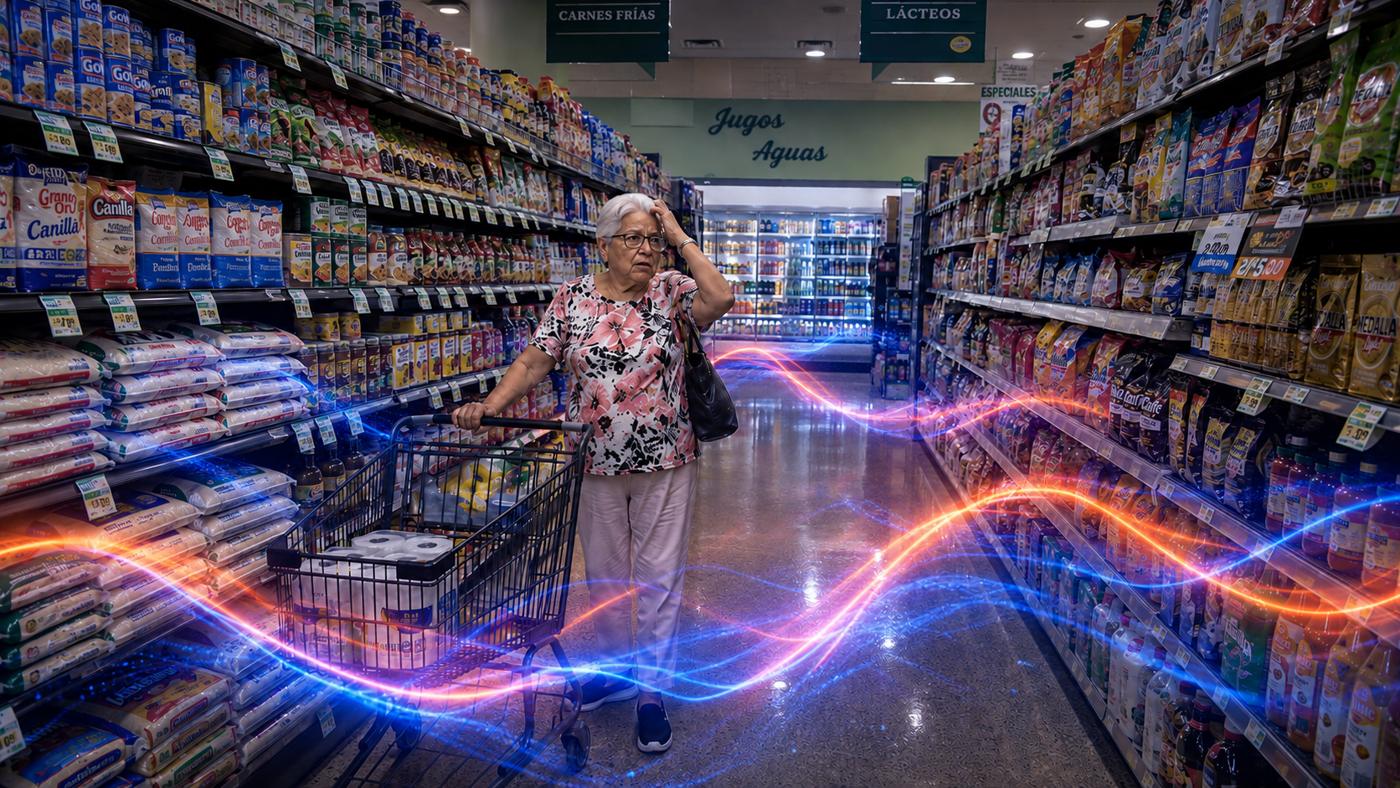
Empty Space
What Puerto Rico’s supermarkets are losing in the aisle
On recent supermarket visits, doing fieldwork for Intelbex clients, I started noticing something most shoppers have probably felt without naming it: it is increasingly difficult to find a floor employee.
There are cashiers. There is security. There are people at the meat counter, the bakery, the café. And there are vendors and merchandisers from individual brands arranging their own product or checking inventory. It is, essentially, one representative per department. But outside those functions, finding someone who works for the supermarket and can actually orient you — help you locate a product, explain the difference between two options, make the trip easier — has become rare.
A conversation that confirmed it
I raised this with an executive in Puerto Rico’s food industry. His read was direct: service in the stores has been disappearing. The floor employee’s role became generic — stock the shelves, clean, keep the area presentable — and stopped including the rest: helping a customer find what they came for, pointing out a new offering, clarifying a price.
Then he said something that stayed with me:
“Little by little, retailers themselves are making it irrelevant to visit the store, and making digital purchasing viable.”
That sentence is the whole article.
The empty shelf
The shelves are full. That is not the problem.
What is empty is the space in front of them. A person standing there, evaluating, with no one to ask.
The decision does not disappear. Something else simply makes it. Shelf space makes it. Brand position makes it. Packaging makes it. Or, most often, price makes it. The most visible or the cheapest product wins, whether or not it was the one that actually solved that shopper’s problem.
And the picture is getting harder. Shoppers now arrive with their minds largely made up. MIDA’s 2026 Consumer X-Ray found that more than nine in ten check what they already have at home before leaving, and three in four arrive with a written list. If the customer walks in decided and no one in the store gives them a reason to reconsider, the visit becomes a pickup errand.
An errand can be automated. And it is being automated: online grocery shopping in Puerto Rico rose from 16% to 19% in a single year.
What brands are paying for and not receiving
For brands, this is not a customer service issue. It is a budget issue.
One MIDA figure makes the point better than any argument: 97% of consumers say they buy products made in Puerto Rico, but only 7% identify them through supermarket signage. The intent is there. The in-store activation is not.
Brands are paying for shelf space in a place where no one defends the product. It is the same principle that explains why membership clubs work: much of what makes Costco and Sam’s effective is the constant presence of promoters offering samples. Someone there still interrupts the inertia and explains something.
This is not solved by hiring
It would be easy to say the answer is more employees. It is not, and any retailer knows why: payroll is the largest controllable expense and the margins are thin. When consumer spending contracts, cutting hours and consolidating functions is the rational response.
The problem was not the cut. It was what got cut. The task was protected and the purpose of the role was let go.
An employee restocking a shelf is already standing in front of the customer at the exact moment of decision. They are already there. The question is whether they know what is in their aisle, what is on promotion, which product is local, and whether they have permission to put the task down and help someone who asks.
That is not hiring. It is training differently, prioritizing differently, and measuring differently. Without the third, the first does not survive a month.
The real question
Setting aside the macroeconomic forces none of us control, the question every operator is left with is this: what are we doing so that our people are not only cleaners, merchandisers, butchers and cashiers, but also promoters, sellers, and customer service?
And for brands: who is explaining the value of your product at the exact moment someone decides?
When spending contracts, competing on price alone limits everyone’s growth. The physical store will keep its value only as long as it offers something a screen cannot offer by itself: human help at the moment of decision.
That space is empty today. Someone is going to fill it.
Data cited: Consumer X-Ray 2026 (Radiografía del Consumidor), MIDA — Puerto Rico’s Food Marketing, Industry and Distribution Chamber.
Lo que los supermercados de Puerto Rico están perdiendo en el pasillo
En visitas recientes a supermercados, haciendo trabajo de campo para clientes de Intelbex, empecé a notar algo que la mayoría de los compradores probablemente ha sentido sin ponerle nombre: cada vez es más difícil encontrar a un empleado de piso.
Hay cajeros. Hay seguridad. Hay personal en la carnicería, la panadería, el café. Y hay vendedores y mercaderistas de marcas individuales acomodando su propio producto o verificando inventario. Es, en esencia, un representante por departamento. Pero fuera de esas funciones, encontrar a alguien que trabaje para el supermercado y pueda orientarte de verdad — ayudarte a localizar un producto, explicarte la diferencia entre dos opciones, hacerte el viaje más fácil — se ha vuelto raro.
Una conversación que lo confirmó
Se lo planteé a un ejecutivo de la industria de alimentos de Puerto Rico. Su lectura fue directa: el servicio en las tiendas ha ido desapareciendo. El rol del empleado de piso se volvió genérico — llenar góndolas, limpiar, mantener el área presentable — y dejó de incluir lo demás: ayudar al cliente a encontrar lo que vino a buscar, señalar una nueva oferta, aclarar un precio.
Entonces dijo algo que se me quedó grabado:
«Poco a poco, los propios detallistas están haciendo irrelevante la visita a la tienda, y haciendo viable la compra digital.»
Esa oración es el artículo completo.
La góndola vacía
Las góndolas están llenas. Ese no es el problema.
Lo que está vacío es el espacio frente a ellas. Una persona parada ahí, evaluando, sin nadie a quien preguntar.
La decisión no desaparece. Simplemente la toma otra cosa. La toma el espacio en góndola. La toma la posición de la marca. La toma el empaque. O, la mayoría de las veces, la toma el precio. Gana el producto más visible o el más barato, fuera o no el que realmente resolvía el problema de ese comprador.
Y el panorama se pone más difícil. Los compradores ya llegan con la decisión mayormente tomada. La Radiografía del Consumidor 2026 de MIDA encontró que más de nueve de cada diez verifican lo que ya tienen en casa antes de salir, y tres de cada cuatro llegan con una lista escrita. Si el cliente entra decidido y nadie en la tienda le da una razón para reconsiderar, la visita se convierte en una diligencia de recogido.
Una diligencia se puede automatizar. Y se está automatizando: la compra de supermercado en línea en Puerto Rico subió de 16% a 19% en un solo año.
Lo que las marcas están pagando y no están recibiendo
Para las marcas, esto no es un tema de servicio al cliente. Es un tema de presupuesto.
Una cifra de MIDA lo dice mejor que cualquier argumento: el 97% de los consumidores dice comprar productos hechos en Puerto Rico, pero solo el 7% los identifica a través de la rotulación del supermercado. La intención está. La activación en tienda, no.
Las marcas están pagando espacio en góndola en un lugar donde nadie defiende el producto. Es el mismo principio que explica por qué funcionan los clubes de membresía: buena parte de lo que hace efectivos a Costco y Sam’s es la presencia constante de promotores ofreciendo muestras. Ahí todavía hay alguien que interrumpe la inercia y explica algo.
Esto no se resuelve contratando
Sería fácil decir que la respuesta es más empleados. No lo es, y cualquier detallista sabe por qué: la nómina es el gasto controlable más grande y los márgenes son finos. Cuando el gasto del consumidor se contrae, recortar horas y consolidar funciones es la respuesta racional.
El problema no fue el recorte. Fue lo que se recortó. Se protegió la tarea y se soltó el propósito del rol.
Un empleado llenando una góndola ya está parado frente al cliente en el momento exacto de la decisión. Ya está ahí. La pregunta es si sabe qué hay en su pasillo, qué está en promoción, cuál producto es local, y si tiene permiso para soltar la tarea y ayudar a quien pregunta.
Eso no es contratar. Es adiestrar distinto, priorizar distinto y medir distinto. Sin lo tercero, lo primero no sobrevive un mes.
La verdadera pregunta
Dejando a un lado las fuerzas macroeconómicas que ninguno de nosotros controla, la pregunta que le queda a cada operador es esta: ¿qué estamos haciendo para que nuestra gente no sea solamente limpiadores, mercaderistas, carniceros y cajeros, sino también promotores, vendedores y servicio al cliente?
Y para las marcas: ¿quién está explicando el valor de tu producto en el momento exacto en que alguien decide?
Cuando el gasto se contrae, competir solo por precio limita el crecimiento de todos. La tienda física conservará su valor solo mientras ofrezca algo que una pantalla no puede ofrecer por sí sola: ayuda humana en el momento de la decisión.
Ese espacio hoy está vacío. Alguien lo va a llenar.
Datos citados: Radiografía del Consumidor 2026, MIDA — Cámara de Mercadeo, Industria y Distribución de Alimentos de Puerto Rico.